This is how thousands of people are still living months after the floods of September 2011.


Views and news from our life as it goes along - from rebuilding ruins in Portugal, adventures in Scotland through post-disaster recovery around the world where disasters and poverty are permanent overlords. These are some of our stories and quests for transition
This is how thousands of people are still living months after the floods of September 2011.
 |
| Morning sun over Eastern wing... Wee bit of that pomegranate poking its head into view there on the left:) |
 |
| Kitchen at night. All LED lights we went for... |
 |
| That kitchen range. A Rizolli (Italiano), 20KW capacity at full blast. This is the heart of the heating system in winter when the sun shineth less. Nikita-built hood there, using part of one of the old floor beams.. |
 |
| Ahhh. The techy part behind it all! So... here's how it works: The white cylinder on the right is heated by the kitchen range, it's 300 litres in size. It will heat the underfloor heating downstairs and a few radiators upstairs. The grey one on the left feeds the showers, taps, etc. and is heated by the solar hot water panels on the roof, when it's sunny, but for those cold 'n' cloudy winter days the white one (kitchen range remember) will heat it up. Plumbers reckon it's more efficient this way (rather than having a massive 600 litre tank). |
 |
| The passive fridge / larder. This has an air inlet from a pipe that runs underground from way outside, and a chimney at the top to allow warm air to get out.. But as the ground temperature is only about 17 degrees constant it never really gets that cold inside... Might need to figure a way to pump in some cold air there (solar heating to cooling set up?)... |
 |
| the utility room / casa das machinas.. |
 |
| From kitchen into the hallway, multitudes of wood going on here.. Local oak post, pine floors, ash and chestnut rafters (holding up the mezzanine), Romanian oak for other floor in kitchen and hall (and windows n doors). |
 |
| Liberian whale and Senagalese cloth making a show.. |
 |
| Kira showing off hallway to kiddy bedrooms, and their bathroom at the end.. (ash posts here on left) on that funny raised "gallery" we haven't quite figured out what we're going to use it for. Pictures I guess. It's covering a bunch of rock that was jutting out from side of the hill we just couldn't face cutting down any more.. |
 |
| Gallery in daytime |
 |
| Standing in that exact same spot where that gallery now is 3 years ago, before we cut down the rock, took down these old roofs, rebuilt the walls, the roofs, and a million other things I'd rather not relive any more (ever again!). The point is, we raised this roof on the left to meet the main roof at the same level, creating that new floor + the mez floor (which was kind of an unexpected bonus now I think of it). Check Paulo on the roof there fixing something as usual:) |
 |
| The pad Nikita built, and now slobs in happily (facebook junkie that he is) |
 |
| Kira's side of the Mez.. equipped with rapid descent system for those emergency response moments |
 |
| The writer's room... |
 |
| Kira's upper deck, leading to Monica's room of requirement (I mean creativity). Dash of colour from Afghanistan here thanks to Yaquub's Turkmen carpet emporium in Islamabad! |
 |
| Descenting downstairs now, Meruch's steps, fair few bits to finish off down here. Argh. |
 |
| so all down here already underfloor heat prepared.. |
 |
| Supposed to be the sitting room / movie zone. But Nikita's turned it into a carpentry workshop! (Kids these days...). |
 |
| Monica's mosaiced shower friend, Haku the river dragon in the downstairs toilet zone... |
 |
| From our one room shelter looking down to the slightly larger main house. So this bothy in foreground took up most of year 2, the monster in the back year 3 and 4.. Or did I loose count? Anyway, lots of covered space! |
 |
| And this was all year 1 pretty much. The house that Paulo built in the background there and then lived in for the next year or so. Ah... those were the days. This was the only functional space on the whole site for SO long. Toilet and shower just behind, kitchen covered there for the winter winds. Solar power for light and stuff. |
 |
| The much used labour party table. Yet to be covered in those kiwis and passion fruit that grow slower than planned.. |
 |
| One of our many avocado experiements.. This one doing not too bad. Seemed to appreciate the old port barrel (who wouldn't at this point?) |
 |
| The compost toilet still going strong after 3 or 4 years. Another class Paulo design n build. |
 |
| bit of detail on the joy-of-lime.. Use both for the render (external plaster) here as well as the pointing. Mix pretty much 2:1 fine sand and lime putty. Plenty shade used for at least 2 weeks after application mind you... This whole wall made of straw bales, using a post&beam timber structure to hold up the roof (local eucalyptus wood - don't let anyone tell you that it's no good for building! The whole roof is made from it too). |
 |
| Beatrix from Galicia, helped design our grey water filtration system - for kitchen / washing machine waste water.. Goes through a grease trap into this gravel pit - that we should have filled with plants by now (our bad), then onto a pond where water plants further treat the water, then onto watering the garden. Loads to learn and and experiment with further here. Oh that red pipe is the air intake for that passive fridge discussed earlier... |
 |
| Blast from the past. 2010 I think, Joao et co, getting the structure in place for the main stairs and east facing downstairs door way (see first picture). Woah, top right of photo is now the kitchen.. Phew... |
 |
| The three musketeers that will carry on for the next adventure, while Nikita goes back to school (finally!) |
 |
| Paulo getting into those window edges.. |
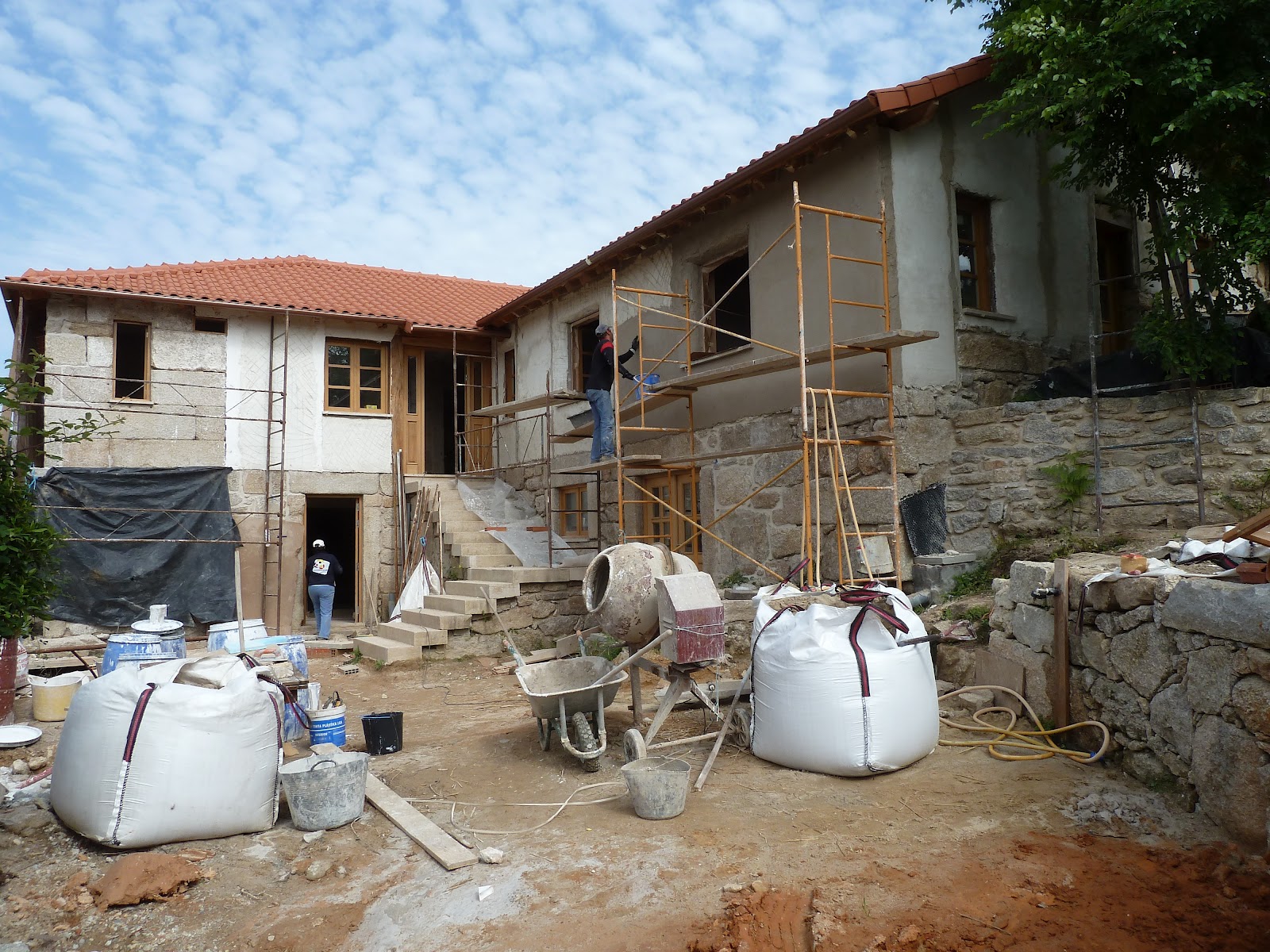 |
| A quarter in on the south wall. |
 |
| Armanda - a fair hand at plastering herself! |
 |
| Where the plaster meets the wood we stapled and nailed on these plastic meshes. We tried to use bamboo strips last time, but they were kinda bouncy. This stuff seems to work well.. So far... |
 |
| Hession as shade to prevent the lime plaster going off too fast. It's supposed to carbonate, absorbing CO2 from the atmosphere. Not dry like cement, so you have to keep it shaded and moist, for about two weeks after it's been applied. |
 |
| Paulo doing his magic around the corners of windows |
 |
| Getting there. With shade up and moistened down with regular water spraying was nice and cool in there.. |
 |
| This taken from the other side of the house - not for rendering. Just finished the pointing - again with lime mortar |
 |
| Nikita's applying a bit of hydraulic lime to the exposed stone bit we also plastered, to help the final coat adhear better. And not have all its water sucked in by the stone.. I guess we'll find out soon if it worked.. |
 |
| Cheeta chilling for a mo |
 |
| So here's where we slaked the lime (quicklime / cal viva). This taken in Feb, when we cleared out the last lot and put in an extra 1200 kgs, added a further 3,000 kgs or so of water, and let it sit for at least three months, so it's properly hydrated and can be used for plastering, pointing and painting. |
.jpg) |
| Solar lights - saving money, increasing safety. |
.JPG) |
| One light and such a difference! |


