I'm going to use this blog to describe how we managed to construct just over 107,000 houses over 4 years, saving almost $70m compared to "conventional reconstruction" models.
Drafting reports and evaluations of this effort I have realised that these
remarkable results may never see the light of day. The whole
endeavour could be forgotten about in a few years as fresh disasters flood
those of yesteryear into distant memory.
About me and my perspective: I've been the shelter advisor to the UK's Department of International Development (DFID) Pakistan since 2010. I have been deeply involved in the design and implementation of this programme so perhaps my view is somewhat biased. I'd like to use this blog (and other publications hopefully) to make this work more transparent - to let more people know and to challenge it. The work described here should help people cope with flooding for years to come; their homes should not collapse next time major floods occur.
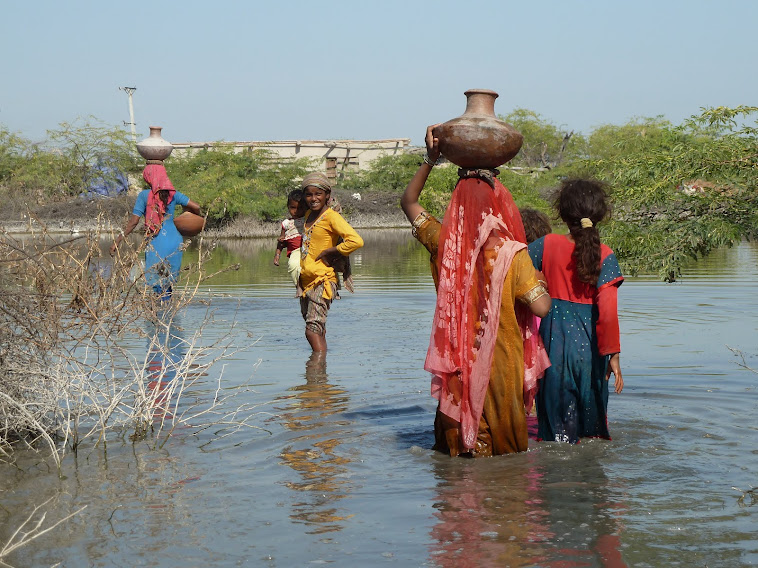
Starting in 2010, severe monsoon rains and widespread flooding
destroyed over a million houses across Pakistan. This led to the world's largest humanitarian
appeal at the time. By September the next year an unprecedented 40
days of rain fell across Southern Sindh, destroying another half a million
earthen homes in conditions an old man told me “in all our lives we've never seen weather like this”.
A year later - 2012 - and another flood – this time a
mind-boggling five days of incredibly intense rain (one year's rainfall in a day in some areas) brought down a further 400,000 houses.
 |
September 2012 - after the floods in Northern Sindh.
(Picture: Joon / Norwegian Embassy who had the chance to survey these floods by helicopter). |
That's around two million homes in ruins which means
that around 14 million people - already battling poverty, malnutrition,
contaminated water, numerous health hazards, find their world inundated, awash
with new problems, debts. And homeless
to boot.
People sometimes ask what is that I do in my job. Well these kind of crisis sets the scene; the tangible suffering and misery you sense when visiting some of the kindest and most welcoming people you are likely to meet anywhere, can trigger an inner call to action. And action, or doing something about the problem, has been my way of translating empathy into something more useful. The other thing about my work is that there's a whole collective of us that do this stuff, and some of the best things happen when good people put their minds together and collective shoulders to the grind stone. And that's what we've been doing these past years, with the people worst affected by the flood. I will try and use this article to let you see their perspective too..
First, a quick summary of the project.
Scale: between 2011 and 2015 this project
supported 107,000 families to build flood-resistant homes. Training on better building practices was given
across thousands of villages to men and women in communities devastated by
floods. Rather than a wave of external
contractors or hired builders rebuilding people’s homes, this has been a
community-led movement that has seen the re-skilling of hundreds of thousands
of people.
|
|
Tharparkar, Sindh (Photojogi village), a home built by people themselves, following design and guidance from our partners covering that area - IOM, their local NGO and training advisors, Heritage Foundation. But the people did the work themselves. Cost : about $350
|
Low-cost: the budget for each reconstructed
home ranges from between £210 to £350 which includes the agency staff,
transport, admin and overheads – as well as the external consultancies
providing training and technical oversight.
In case you’re wondering this IS a remarkably low price for a
flood-resistant house which should last for generations.
In comparison, most housing supported in the
post-flood (after 2010) was costing around
£750 – many models costing twice that. So, this is a saving of around
£50m ($70m) across the 107,000 target shelters.
This “saving” has of course been used in the project itself and has been
translated into thousands of additional families living in houses that should withstand future floods.
Low-carbon: By choosing to avoid fired bricks and cement wherever possible this project has saved approximately 370,000
tonnes of CO2. This is equivalent to 3 days emissions from the city of London,
24,000 Brits carbon emissions for a year, or 170,000 inter-continental return
flights. I have calculated these
emissions reductions using a peer-reviewed life cycle analysis of building
materials from around the world. See footnote for source.
 |
Lime stabilised soil blocks:
Various different mixes of soil and lime are tested underwater for
months before the correct ratio is selected. |
Lime: Used for almost 5,000 years lime is one
of mankind’s oldest building materials. Formed over 300 million years ago from
a previous time of extreme global warming lime is far more than an additive, it
has been the key stabilising material that can turn ordinary soil into completely
water-resistant blocks. By employing a
basic formula and tests used by Roman builders 2,000 years ago, the lime
consultants from Strawbuild UK have
shown local villagers how to experiment with their locally available soil until
they find a mix that can sit underwater for months, indeed, indefinitely. This
happens when lime is combined with the right amount of clay (or volcanic ash if
you happen to have it) to create hydraulic lime – known to solidify
under-water. The entire village can see this process – earth bricks thus made
remain steeped in buckets of water indefinitely. The “seeing is believing”
adage couldn’t be more true in this case: local people are so confident in the
ability of their building materials to withstand water that a visitor will be
greeted by a lecture on the finer arts of lime construction in remote villages
across the land.
Linking emergency-recovery and resilience:
three consecutive floods from 2010 – 2012 meant that humanitarian organisations
were often responding to emergency shelter needs (people literally displaced on
roads or any higher ground) at the same time as working on durable shelters in
another part of the region from a previous years' flooding.
 |
A "roofing kit" designed by HANDS - inlcudes a steel girder two plastic sheets, enough bamboo poles for a roof in the future a solar lamp and a water filter. The design of this temporary shelter could be improved but it's what people decided on. The main point is that these materials can be used in the reconstruction phase, which a tent, for example, cannot.
|
Realising
the inevitable link between these phases of recovery one of our local partner organisations,
HANDS, developed a roofing kit that would provide ample accommodation in the
emergency phase and be dismantled and brought home when return was possible.
Here it could be re-used for semi-permanent transitional shelter and again a
third time when the funds for durable, flood-resistant shelters were raised.
Costing no more than £70 ($100) the kit included sufficient bamboo poles for a
normal roof (and a good sized temporary shelter), plastic sheets and a steel
beam that would become the central structure of the temporary and, later, the
permanent dwelling. This may be the
first time in Pakistan that building materials have been used across the “relief to
development continuum”; it has also reduced the cost of providing shelter
support to the same family twice. In fact it has enabled HANDS to become our largest shelter partner, reaching over 50,000 families over this period.
Another important factor:
 |
OK here's me (eeks) - in a village in Jacobabad, North Sindh, where I'd visited a couple of years before, and was bringing them a picture from that last trip. Staying on the same programme for years means you can understand better what works and what doesn't (as well as keeping in touch!).
|
Sustained donor engagement: the fact that DFID
approved the submissions from the humanitarian team at DFID Pakistan year after
year, sustaining a focus on shelter (as well as livelihoods) has been critical
to the success and continuity of the programme. Indeed DFID has been the
leading donor in the shelter sector since the 2011 floods, contributing over
£30m towards this effort. This enabled a
British shelter adviser (er, me) to remain engaged with DFID-Pakistan, living
in Islamabad through most of the project period, travelling extensively across
every district and meeting beneficiaries in hundreds of villages.
 |
A home made with lime-stabilised earth blocks supported by ACTED (NGO). The large shading is to protect the render from
sunlight while the lime render cures properly (it shouldn't dry too fast). |
So far this project has reached around 750,000 people across flood-prone
areas in Sindh, Southern Punjab (Rajanpur specifically) and two districts of
Eastern Baluchistan.
 |
| So much of this process is about community engagement. Here in a community HANDS was working in Mirpukhass they had encouraged community-based-organisations to plan their own recovery. One each for men and women. And wow! they were so vocal, active and engaged it's always inspiring. This is one of thousands of Hindu communities that live across SE Sindh, in peace with their Muslim neighbours - and without any kind of persecution from the Government it has to be said. |
 |
Love this picture because it says so much about who benefits from this
work. A large "female headed" family, who were living in a basic shack
for almost two years after the floods. And Waqar, in the background,
one of our DFID drivers who used to love coming out on these visits
(we did so many together) |
OK, so that’s the overview of the project. Why is this such a big deal? Well… Extreme
flooding is becoming a regular event in Pakistan (Nepal and India too) made
worse by climate change but also really inappropriate land management further up the
watershed. For example, the rampant deforestation in Northern areas means less
water is held higher up the landscape. Without trees and vegetation on the land
water flows downhill as the natural means to hold it has been taken away (often
by unscrupulous “timber mafia” who get away with clear cutting). I’ve heard
Pakistan’s forest cover has reduced from about 25% to 3% over the last 50
years.
Bad news. So, systems and technologies to build
affordable homes that can cope with annual flooding are going to be needed for
generations to come. What we’ve done
here is prove that a model exists that doesn’t need to cost the earth. But the problems further "upstream" really need to be tackled to in a long-term landscape regeneration programme at enormous scale.
 |
Classic "Chora" house in Tharparkar district (SE Sindh) which the family rebuilt
with support from Heritage Foundation, IOM and their local NGO partner. |
This initiative shows that it's possible to take an alternative, low-cost, low-tech and
low-carbon reconstruction programme to scale - that is: not limited to a few hundred houses as alternative projects often are.
Our amazingly dedicated partners trained men and women in some really
isolated places to build houses to a high standard. People who were
mostly illiterate – but dilligent and committed. Now, as I move around other countries of the
world I see how many other flood-prone communities could use some of these skills, so to start
off I'm going to write about what we did in Pakistan, how and why, how much it
cost, then you can decide if it's worth taking further.
Local and
traditional building (vernacular architecture)
Vernacular building in much of rural Pakistan consists of earthen or thatch
walls, seldom stabilised or water resistant.
Fired bricks are available, but they are expensive, so the vast majority
produce their own sun-dried mud bricks – using the earth around them. Our aim here was to work with the vernacular, find ways to improve and enhance it, to make the design and materials changes necessary to allow homes to be flood resistant.
 |
Made with wood and straw, covered in mud, with no roof eaves these houses are vulnerable to intense rainfall as the walls can collapse from the top down.
|
Roofs provide
scant protection from the rains; there are rarely protruding eaves, which
leaves the entire house all too exposed to heavy downpours: water penetrates
and softens the tops of the earthen walls until they cannot support the weight
of the roof and the whole shelter collapses.
 |
| Other types, these from Southern Sindh, with twin-pitch roofs, with better eaves over the walls. But the walls collapse when submerged for too long. |
Partnerships
The project was a product of a close partnership
between DFID-Pakistan and several local and international organisations. The
main implementing partners, between 2011 and
2014 were: Health and Nutrition Development Society (HANDS), a Karachi-based
local NGO, the International Organisation for Migration (IOM), a UN agency, and ACTED, an international NGO.
 |
Ghulam Mustafa, from HANDS, who has also
stayed the course over all these years. A really
dedicated humanitarian dude! |
Two other organisations contributed technical design,
materials consulting, advice and training: Heritage Foundation – a
Karachi based NGO working in cultural heritage restoration and in traditional and natural building, who worked
with IOM and local communities to rebuild using local materials, especially
bamboo and lime; and Strawbuild,
a UK-based consultancy firm specialising in natural building systems.
Strawbuild developed detailed training on working with lime (CaCO3)
and worked with all three implementing NGOs - Hands, IOM and ACTED - to
incorporate lime in their building materials and practice.
 |
Yasmeen Lari, founder of the Heritage Foundation, Pakistan's first
lady architect and now one of its strongest and relentless advocate
for natural building, heritage conservation and preservation
of vernacular architecture. |
 |
Manuel Pereira - unstoppable project manager of IOM an
engineer from Lisbon whose energy and diligence was
unparalleled and an inspiration. |
 |
Yousif Aziz, squatting during a community meeting,
shelter manager from ACTED, another
great colleague since late 2010 when we started
collaborating on housing - and still going. With
this experience Yousaf and others should be senior
shelter advisors in Pakistan going forward. |
 |
Bee Rowan, founder of Strawbuild, one of the most passionate
advocates for natural materials, with decades of training and
design experience in lime and other natural materials. |
 |
Ammarah Mubarak, humanitarian coordinator at IOM Pakistan
since 2010 who has overseen one of IOM's most
impressive shelter cluster (coordination) and large scale
responses after every disaster. This kind of long term
commitment stability is invaluable. |
Project Ambition – what were the intended outcomes?
Ultimately, the point of all this effort has been two-fold: restore people's homes and to
reduce the impact of future floods for people living in areas that are likely
to be exposed to extreme weather events.
By reducing the impact we'd also hope to reduce, to some extent, people's vulnerability to “natural hazards”,
to increase their resilience to these predictable threats.
Vulnerability
(and resilience) are however complex issues and it would be wrong to assume
that a stronger home, by itself can fix all the problems. For people that face myriad problems like
having only contaminated water to drink, barely any power or energy services,
denuded, deforested landscapes, chronic malnutrition, unequal access to land,
limited work and training opportunities, no access to financial credit,
insurance, dysfunctional judiciary systems – vulnerability means living in the
shadow of all these combined overlords of poverty.
In terms of ambition, I think this is one of the largest shelter programmes in the world that has supported so many local people to build flood-resistant houses at such a low price, avoiding enormous atmospheric pollution, using lime and other natural, affordable, locally-available materials. So far the project has helped around 750,000 people across flood-prone areas in Sindh, Southern Punjab (Rajanpur specifically) and two districts of Eastern Baluchistan.
 |
| For years after all of the major floods people lived in shacks like this, shown in the foreground, using some basic materials (they hadn't received the longer term roofing kits, which came later). The building behind has just been finished by the family - the older couple's son still displaying recent plastering work on his shalwar khamiz! But this just shows how a (hopefully) durable shelter can help move people from vulnerability and deprivation to a place of more confidence and ... resilience. |
Environmental and Social factors - should we put a value on these?
I'd recently completed a Masters in sustainable building and energy, so I, like every other graduate couldn't help but see the environmental impact of modern, energy intensive building materials - especially when there are so many low-carbon alternatives that do the job just as well.
Emissions and pollution from brick kilns, cement production, local deforestation all contribute to a more denuded and vulnerable ecological landscape that leave people much more at risk from floods or storms. Which in turn are more severe because of excessive global pollution and climate change. A viscous cycle.
Brick production in Pakistan should be understood by those building anything - if environmental and social impacts are counted and valued at all. The major brick kilns are largely unregulated and are mired in reports of unethical
treatment of workers such as bonded and child labour and
gruelling working conditions. Should humanitarian organisations be buying from unethical suppliers? Arguably, buying such bricks exacerbates environmental and public health crises, while condoning human rights violations. (Many an essay topic in there).
|
|
Women were at the forefront of rebuilding their own homes. This example from Badin in Southern Sindh, following a Heritage Foundation design, which promoted massive foundations and "toes" and raised platforms to increase
flood resistance.
|
The reconstruction projects are, by design, community-led. Each partner worked closely with each village, seeking active engagement and participation. In many cases the partner NGOs formed community based organisations (CBOs) including both men and women (jointly or separately); these became dynamic focal points for community action – beyond the housing project. For example, some CBOs are using their new capacity for organisation and collective “voice” to articulate wider needs and priorities.
How the money transferred..
Community members themselves managed the funds provided for purchasing shelter materials; this meant people were in control of the process. The payments are split over three tranches, each following the completion of an agreed building phase (such as foundations, top of walls, etc.). This way the people are in control of procurement, liaison with traders, timing of deliveries and funds administration. Regular monitoring by the implementing partners (and us, in DFID) revealed that there has been little or no misuse of the reconstruction funds. This approach has also saved enormous resources otherwise spent on the rental of warehouses, trucking contracts etc. Instead, market traders came to the communities to sell their wares, paying their own transport, managing their own logistics.
Funding:
£30m over three years has been provided by
DFID based on detailed proposals submitted by the implementing partners. That's about £40 a person - or £280 a family - which includes all agency overheads, staff, technical consultants, DFID oversight, etc.
So, to summarise... here are some LESSONS LEARNED
- Link the response to emergency shelter needs to
longer-term, durable housing. It
makes more sense than investing twice for the same objectives. Think long term when you programme an
initial response.
- Use lime in flood areas. There is ample evidence that lime
resists water better than any modern material. This dates back from the Roman and Indus
civilisations - whose structures, built over 5,000 years ago, are still
standing in Northern Sindh.
- Lime is a complex material that requires training
from experts with appropriate experience.
It is not like cement that can be mixed in a simple ratio with sand
or earth. It requires extensive
local testing and research before it can be used at scale. Make sure you plan in at least 3
additional months for this research.
- Promote community mobilisation and engagement
from the beginning. Reinforce
beneficiary ownership by giving control of local expenditure to the
community, rather than external agencies.
- Deal with other issues in the community while
engaged in the housing. Can the
low-cost building blocks be used to build latrines too? Why not address
the health crisis sparked by the use of sub-standard cook-stoves by
introducing better models?
- Involve local academia wherever possible. Local
students are thrilled to be engaged in ongoing projects. This way more
people observe, learn, practice and can disseminate the lessons that
emerge. [We so need to do better in this regard...].
- Publish findings, encourage discussions and spark
debates – make these projects widely known through journals, films and
articles, so they don’t remain isolated cases closed to anyone who wasn’t
directly involved in the project.

1 University of Bath, Embodied energy and carbon
in Construction materials (2008). Available at:
https://www.circularecology.com/nuqdjaidjajklasah.html