Tuesday, 23 July 2013

How to reverse desertification

Last month Nikita and I visited Tamera in the far South of Portugal -  a parched landscape of rolling hills, rolling fields once dedicated to intensive wheat production, then intensive grazing, now exhausted and denuded.  In their wisdom the Government with EU funding has introduced mono-culture eucylptus and pine plantations, which will exacerbate the water crisis in this area, increasing fire risk and bring virtually no sustainable economic opportunities to local communities.  

We came to see an alternative land-use option.  To learn how you can turn this into an area of perpetual productivity and an oasis for biodiversity.

It looks like this - for mile upon mile (this photo taken on the adjacent watershed / valley to Tamera, so it shows how it would have looked like before the project began.
Annual rainfall here: about 600mm - about half the amount of Northern Portugal or the UK


We arrive mid-afternoon and are immediately shown around by Cristophe a graduate of forestry from Germany; he is passionate about their project and completely familiar with each aspect of its design and implementation which makes for a brilliant walk-through and presentation.  And the best thing was learning about it all as we walked the land and learned physically what we were hearing.  Being there makes such a difference.


So their plan is simple: establish dams across the valley in as many places as you can. This means getting diggers down there and increasing the depth of the valley a bit and using all this material to form the dam.  This one shown above is their newest lake - only a year old - filled by just the winter and spring rains.  In the foreground you can see a solar pump that moves some of this water uphill further for vegetable production.


Move a few meters to the left and this is what you see. The road sits on the top of the damn. The water on the left of the picture is part of the next dam further down.  Cristophe explained that the dams hold the water, plenty of it infiltrates into the ground, but once it is saturated it slowly spreads to the surrounding land.  

Without these dams all this water would have run through the valley and away to the sea.  The parched earth would remain dry.


Cristophe explaining the design of one of their older lakes, this one five years old I think..

Incredibly detailed planning went into the underwater design as well - shallow areas for reeds for fish breeding and other wildlife, a deep section in the middle to increase overall volume and to maintain some cold water sections, some "shelves" or terraces for various other biodiversity benefits.  

At ground level they have planted thousands of trees. At first there are fruit, nut and other deciduous species, close to the water, followed by a terrace about 3 or 4 meters wide, then another band of trees, then another area of veg production.  

This photo shows the stages of tree plantations, only five years on. There's a new veg bed on the terrace between them which does need some irrigation during the long dry months, but the trees benefit from the increased water available in the water table. 

Think back to the first picture - arid, brown, dry and denuded landscape. THis looks (and feels) more like France or Southern England. It is much cooler with all the shade and water around, and they say that the lakes create increased breeze down the valley as well.  

Nice to see that some beds were dedicated to seed production only.
I haven't seen this kind of thing before - vegetables all allowed to go to seed
and get on with securing their reproduction


7 years on, trees now well established creating their own micro-climate,
all possible because of the water that is now retained for longer time by the dams. 


Finally - a reminder of how this land looked before they started here.  I walked up here the day after our tour and couldn't help seeing all the little valleys and creeks that could be dammed up to create zones of regeneration and biodiversity.  

And then imagine what it could transform in some really arid countries where people suffer constant food insecurity, droughts, floods.  Here is a design alternative that could solve all those problems. 

Tamera is about much more than this.  For more info see their website here


Saturday, 2 March 2013

28 months after

This is how thousands of people are still living months after the floods of September 2011.


Thursday, 15 November 2012

Photo from field trip

Does the photo even appear?

This from today's trip in Shikarpur in Sindh


Sunday, 15 July 2012

OMG the house is finished?? Hello life!

The house is finally finished, well more or less. Liveable at least. The vital signs are there: hot water and showers that work (a solar hot water + wood fired kitchen range combination which works just amazing), toilets that flush into the biogas septic tank that needs some, er, fine tuning, lights that turn on (wow), plugs that work, and so on..

Before we head off for a whole new family chapter in Pakistan (long story, perhaps another time) here’s a few photies of the place these days… 


Morning sun over Eastern wing... Wee bit of that pomegranate poking its head into view there on the left:)

Kitchen at night. All LED lights we went for... 
That kitchen range. A Rizolli (Italiano), 20KW capacity at
full blast. This is the heart of the heating system in winter
when the sun shineth less.  Nikita-built hood there, using part
of one of the old floor beams..


Ahhh. The techy part behind it all! So... here's how it works:
The white cylinder on the right is heated by the kitchen range, it's 300 litres
in size. It will heat the underfloor heating downstairs and a few radiators
upstairs. The grey one on the left feeds the showers, taps, etc. and
is heated by the solar hot water panels
on the roof, when it's sunny, but for those cold 'n' cloudy winter days the
white one (kitchen range remember) will heat it up. Plumbers reckon it's more
efficient this way (rather than having a massive 600 litre tank). 

The passive fridge / larder. This has an air inlet
from a pipe that runs underground from way
outside, and a chimney at the top to allow
warm air to get out.. But as the ground
temperature is only about 17 degrees constant
it never really gets that cold inside...
Might need to figure a way to pump
in some cold air there (solar heating to
cooling set up?)... 
the utility room / casa das machinas.. 


From kitchen into the hallway, multitudes of wood going on here.. Local oak post, pine floors, ash and chestnut
rafters (holding up the mezzanine), Romanian oak for other floor in kitchen and hall (and windows n doors).
Liberian whale and Senagalese cloth making a show.. 


Kira showing off hallway to kiddy bedrooms, and their
bathroom at the end.. (ash posts here on left) on that
funny raised "gallery" we haven't quite figured
out what we're going to use it for. Pictures I guess.
It's covering a bunch of rock that was jutting out
from side of the hill we just couldn't face cutting down any
more.. 


Gallery in daytime


Standing in that exact same spot where that gallery now is
 3 years ago, before we cut down the rock, took down these old roofs, rebuilt the walls, the roofs,
and a million other things I'd rather not relive any more (ever again!). The point is, we raised this
roof on the left to meet the main roof at the same level, creating that new floor
+ the mez floor (which was kind of an unexpected bonus now I think of it).
Check Paulo on the roof there fixing something as usual:)


The pad Nikita built, and now slobs in
happily (facebook junkie that he is)

Kira's side of the Mez.. equipped with
rapid descent system for those
emergency response moments


The writer's room... 
Kira's upper deck, leading to Monica's room of requirement
(I mean creativity).  Dash of colour from Afghanistan here thanks
to Yaquub's Turkmen carpet emporium in Islamabad!


Descenting downstairs now, Meruch's steps, fair
few bits to finish off down here.  Argh.


so all down here already underfloor heat prepared..


Supposed to be the sitting room / movie zone. But Nikita's turned it
into a carpentry workshop! (Kids these days...).  

Monica's mosaiced shower friend, Haku the river dragon
in the downstairs toilet zone...


From our one room shelter looking down to the slightly larger main house.
So this bothy in foreground took up most of year 2, the monster in the back
year 3 and 4.. Or did I loose count? Anyway, lots of covered space!


And this was all year 1 pretty much. The house that Paulo built in the background there
and then lived in for the next year or so. Ah... those were the days. This was the
only functional space on the whole site for SO long.  Toilet and shower just behind, kitchen covered
there for the winter winds. Solar power for light and stuff.  

The much used labour party table. Yet to be covered
in those kiwis and passion fruit that grow slower than
planned.. 

One of our many avocado
experiements.. This one doing
not too bad.  Seemed to appreciate
the old port barrel (who wouldn't
at this point?)


The compost toilet
still going strong after 3 or 4 years. Another
class Paulo design n build.


bit of detail on the joy-of-lime.. Use both for the render (external plaster)
here as well as the pointing.  Mix pretty much 2:1 fine sand and lime putty.
Plenty shade used for at least 2 weeks after application mind you...
This whole wall made of straw bales, using a post&beam timber structure
to hold up the roof (local eucalyptus wood - don't let anyone tell you that
it's no good for building! The whole roof is made from it too).


Beatrix from Galicia, helped design our grey water filtration
system - for kitchen / washing machine waste water..
Goes through a grease trap into this gravel pit - that we should
have filled with plants by now (our bad), then onto a pond
where water plants further treat the water, then onto
watering the garden.  Loads to learn and and experiment with
further here.  Oh that red pipe is the air intake for that passive
fridge discussed earlier... 


Blast from the past. 2010 I think,  Joao et co, getting the structure in place
for the main stairs and east facing downstairs door way (see first picture).
Woah, top right of photo is now the kitchen.. Phew...


The three musketeers that will carry on for the next adventure, while Nikita goes back to school (finally!)

Monday, 14 May 2012

final plaster (rendering) with our lime putty


So, this weekend we embarked on the final external plaster of the straw bale bit of the house. We put a base coat on a year or so ago, made up of lime putty, sand and chopped straw, so it was water-tight. But we needed the final coat on so we could be done with the scaffolding and wrap up things outdoors before our building liscence (planning permission) expires in a couple of weeks..

Paulo getting into those window edges..
So the maestro of the day is Paulo, a local builder and his wife Armanda. They work weekends only on jobs like this. But had never seen nor heard of a lime plaster.  Everyone here uses a cement-based plaster, which is a lot easier to prepare, etc. but doesn't breath at all. It's kind of like wearing a really heavy plastic jacket on a warm day. You'd get wet from the inside right? (cos your sweatiness couldn't get out).  Well buildings are the same - they breathe; we breath in them, vapours abound in houses, from people, kitchens, showers and so on.  Without breathing walls we need mechanical ventilation and there are few of these that actually work properly.  So it just seems nuts that people don't use lime more. Lime breathes, yet is waterproof. The equivalent of a gortex jacket... 
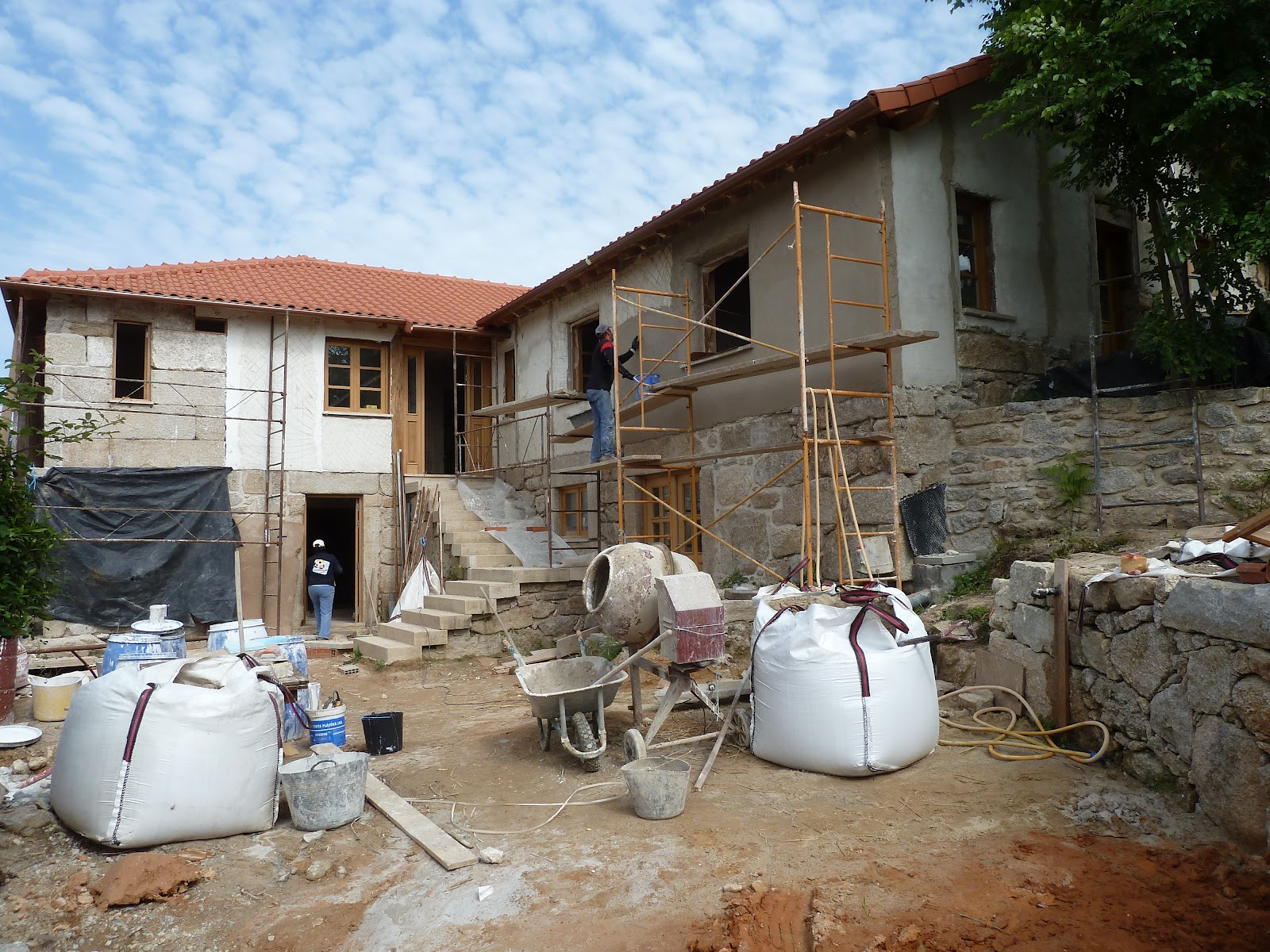
Anyway, here's some photies

A quarter in on the south wall.
Armanda - a fair hand at plastering herself!

Where the plaster meets the wood we
stapled and nailed on these plastic meshes.  We tried to use bamboo strips last time, but they were kinda bouncy.
This stuff seems to work well.. So far...


Hession as shade to prevent the lime plaster going off too fast. It's supposed to carbonate, absorbing CO2 from the atmosphere. Not dry like cement, so you have to keep it shaded and moist, for about two weeks
after it's been applied.  

Paulo doing his magic around the corners of windows

Getting there. With shade up and moistened down with regular water spraying was nice and cool in there..

This taken from the other side of the house - not for rendering. Just finished the pointing - again with lime  mortar

Nikita's applying a bit of hydraulic lime to the exposed stone bit
we also plastered, to help the final coat adhear better. And not have
all its water sucked in by the stone..  I guess we'll find out soon if it worked..

Cheeta chilling for a mo

So here's where we slaked the lime (quicklime / cal viva). This taken in Feb, when we cleared out the last lot and put in an extra 1200 kgs, added a further 3,000 kgs or so of water, and let it sit for at least three months, so it's properly hydrated and can be used for plastering, pointing and painting.


Sunday, 1 April 2012

advanced use of solar energy

This has to be one of the most exciting developments in low cost, community based renewable energy systems around - and comes from decades of research and experimentation by German physicists, inventors, engineers and enthusiasts. And - it's all been done on really low budgets, so it might just work to address the multiple energy, food, water troubles faced by people all over the developing world.  Need to do the economics and some test models... Let's see.

Also, it would make sense combined with a biogas system and planting of as many trees as possible to deal with heat, food security, watertable management and soil regeneration.

Hmmm, need to build up a series of these relevant technologies.  new site?

Tuesday, 13 March 2012

Solar lights - saving money, increasing safety.
In an earlier post I talked about the rationale of including cheap solar lights in future emergency relief kits distribution: it just makes so much sense. We (DFID) supported 12,000 of these last year through CONCERN and their local partners in Sindh. I went to visit these some of these communities a year later and the lights, made by Toughstuff were still doing well and people said they appreciated them so much. Many folk were using them to charge mobiles too.  This was part of our 2010 response.

Following intense rains in 2011 another few hundred thousands families lost their homes and livelihoods, so we launched more support and response.  (Again DFID being in the top 5 donors, yeh!).  This time we're supporting the reconstruction of more than 30,000 houses, but also distributing around 28,000 lights. This time using illumination products. These cost around $7 per unit (at this scale), so about half the price of the Toughstuff ones.  The difference is that they can't charge mobile phones, but we decided that it was more important to reach as many families as possible with the limited funds we could put forward.

Here's a video IOM put together about their response:


It's not our role to tell our partners where they should buy their products, I just made it clear that they should include these in the kits, or give us a good reason why they shouldn't be included.  Here's the deal: after disasters NGOs and UN agencies provide shelter and non-food items (NFIs), among loads of other sectors of support (health, food, etc.).  Shelter is a huge issue and there are many different options, which are we'll have to talk about another another day. But NFIs are also the subject of huge debate, in fact there's been over a decade of efforts to standardise these kits.  Obviously they depend on the climate, but they usually include blankets, sleeping mats, jerry cans (for storing water), cooking sets, mosquito nets, soap, hygiene kits, and so on.  These can cost a lot of money, and when there are millions of people to help, it can quickly diminish a few million pounds.  So, what are the critical items? How do we decide? Should we accept what the NGOs propose or should we request justification for every item so that more families benefit from something? These are hard decisions, but I think it's good that we have these discussions.

So when it came to this 2011 response, our first main partner was the International Organisaiton for Migration, a really professional outfit that has enormous experience in Pakistan, a really committed, mostly national team, supported by a few solid internationals. They come with really quite reasonable overhead costs, which is increasing important to us (very few international staff costs, flights, and all that admin horror of daily mail doom).  They did a sterling job running the shelter cluster after the 2010 floods, and are doing that same job this year, again really well.

One light and such a difference!

IOM's procurement unit did a market survey on different solar light units and initially proposed a chunky unit costing around 15 pounds.  After a fair bit of technical review we agreed to go for the illumination unit which gives pretty good light for at least 6 hours a night, at one third the cost! For the 18,000 families we intended to reach this meant a saving of almost half a million pounds:) We also slashed cooking sets (as most people had recovered a few cook pots). This saved another 360 grand (pounds sterling). Together, these savings meant another 2,500 families could be reached.  When you meet one of these families you know why every one counts.


I just wanted to bring this up to show how we're dealing with this value-for-money issue (a new DFID-buzzword). But really relevant in these times of economic woe, and particularly when DFID is defending its position in the light of budget cuts in other areas of life in UK.  So it's fair enough that we make sure every pound spent makes sense, and where savings can be made they are made.  And where possible we do more for less, reach more people for the same money.  I suppose we're custodians of people's money in this way, we have to make the right call. I hope this programme is an example of this in action, but I'll leave you to decide if that's the case or not.


More photos of these units in use were taken by IOM's team on the ground recently and are here: https://www2.dropbox.com/home/solar%20lights%20pakistan